I. Justification of the Research Topic
1.1 Background of the Topic
In 2020, an article titled "Food Delivery Riders Trapped in the System" published in People magazine attracted widespread public attention. However, five years later, the problem has not only remained unresolved but has intensified due to intensified platform competition and declining service prices. This constitutes a classic case of the "alienation of humans resulting from technological progress," carrying significant social-critical implications.
In recent years, cases of "low-ranking officials engaging in massive corruption" have repeatedly shocked public perception. In 2024, disciplinary agencies across the country punished over 300,000 rural and community Party members and officials; among them were village Party secretaries and village heads involved in embezzlement amounting to tens of millions or even hundreds of millions of yuan. Despite their relatively low official status, these individuals controlled vast sums of money related to land acquisition and demolition, collective assets, and agricultural subsidies—constituting the most egregious forms of "visible corruption."
Simultaneously, the state allocates trillions of yuan annually for rural revitalization initiatives. The critical question remains: how much of this funding actually reaches the fields and benefits local farmers?
1.2 Why This Topic Deserves Research
First, the stark contrast inherent in these cases confers strong communicative potential.
- A village Party secretary, with a monthly salary of merely two to three thousand yuan, is able to construct a mansion resembling the Forbidden City, arrange a wedding costing millions for his daughter, and emigrate overseas with his family.
- In a national-level poverty-stricken county, village officials drive Porsche cars to attend meetings in town.
- While the average annual income of villagers remains below 5,000 yuan, the village collective accounts show a deficit of tens of millions of yuan.
Second, the underlying issues are far more complex than merely "cracking down on corrupt officials."
| Level of Inquiry | Core Questions |
|---|---|
| Institutional level | Why do village affairs disclosures remain ineffective? Why does villagers’ right to oversight fail to materialize? |
| Power dynamics | How can a village Party secretary, operating under a "one-man rule" system, remain in office for 20 years? Why do higher-level township authorities turn a blind eye? |
| Cultural factors | How does the convergence of clan influence and grassroots governance give rise to the phenomenon of "local tyrants"? |
| Economic aspects | Given the lengthy approval processes and multiple regulatory layers for rural revitalization funds, which stage is most susceptible to diversion? |
Third, critical perspectives for analysis:
- Why are "minor corrupt officials" so difficult to eradicate? Village officials serve as the most grassroots-level "representatives of the people"; they interact closely with villagers daily. Reporting them often leads to confrontation and retaliation. The phenomenon of "fear of oversight" warrants deeper reflection than the mere absence of oversight mechanisms.
- The "paper reality" of oversight systems: Village affairs supervision committees, villagers’ financial management groups, and procedures such as "four deliberations and two disclosures" reflect comprehensive institutional design. Yet in practice, these often function as mere formalities. Is the problem rooted in design flaws or implementation failures? Who bears responsibility?
- The governance paradox of "acquaintance-based societies": Rural China is characterized by a culture of personal relationships; village officials often belong to influential clans or local elites. When personal relationships override formal rules, how can the rule of law penetrate the grassroots level?
- The multiplier effect of "petty corruption": Although individual amounts may seem small, the scope and frequency are vast. Kickbacks on road construction projects, handling fees deducted from agricultural subsidies, or exploitative practices in land transfer—each act erodes the foundation of grassroots governance and undermines villagers’ trust in the government.
- The "hidden costs" of rural revitalization: The greater the state investment, the wider the room for discretionary action at the grassroots level. Could intensified anti-corruption efforts inadvertently lead to a situation where grassroots officials become hesitant to act? How can a balance be struck between strict oversight and effective incentives?
1.3 Further Reflections
The true significance of this topic lies not in quantifying the extent of corruption, but in addressing a fundamental question: When the state’s goodwill is distorted by local power structures, who will restore the trust of hundreds of millions of farmers in grassroots governance? Rural revitalization encompasses not only economic development but also governance reform. If the "last mile" of governance remains blocked, even substantial financial inputs will prove futile.
II. Case Studies
Case 1: Zhang Jinming from Hechuan, Chongqing – Ten Years of Exploitative Practices
Zhang Jinming served as the Party secretary and village head of Laolong Village, Sanhui Town, Hechuan District. From October 2013 to December 2024—spanning eleven years—he, along with other village officials, systematically extorted benefits from every project implemented in Laolong Village.
Ultimately, it was established that he embezzled over 3 million yuan of collective funds and accepted bribes exceeding 1.1 million yuan.
Five village officials were expelled from the Party, and their cases involving criminal charges were referred to prosecutorial authorities.
Key observation: Eleven years. A village official, operating openly under the watchful eyes of villagers, exploited every project that came to the village for a decade. This was not concealed misconduct but overt exploitation, revealing not merely individual greed but the complete breakdown of oversight mechanisms.
Case 2: Yu Moumou from Jingxian, Anhui – A 3.654-Million-Yuan "Mountain Land Business"
From 2016 to 2024, Yu Moumou, the former Party secretary and village head of Chaji Village, Taohuatan Town, Jingxian County, exploited his position to facilitate private gains for others in mountain land contracting and construction projects, accepting illicit payments totaling 3.654 million yuan.
In June 2025, Yu Moumou was sentenced to three years and eight months in prison.
Key observation: Chaji Village is a nationally recognized historical and cultural village attracting numerous tourists annually. The village Party secretary’s control over "mountain land contracting rights" and "construction project awards" amounted to a monopoly over public resource allocation. The 3.654 million yuan was not merely a bribe but the proceeds of conducting business using public power.
Case 3: Huang Mou from Xuyi, Jiangsu – A 1.6-Million-Yuan "Interest-Free Loan"
During his tenure as Party secretary and village head of Zhuxiang Village, Huang Mou misappropriated 1.6 million yuan of land acquisition compensation funds intended for villagers and transferred them to his personal bank account. He used these funds—without recording them in official accounts—to repay bank loans, finance personal business activities, and cover household expenses.
This continued for nearly two and a half years.
It was only in August 2024, when the fifth inspection team of the Xuyi County Party Committee examined the management of the village’s "three types of assets" (funds, assets, and resources), that Huang Mou, fearing exposure, deposited the 1.6 million yuan into a government-designated account.
Key observation: 1.6 million yuan—villagers’ land compensation funds—was treated by the village Party secretary as an "interest-free loan." More critically, the question arises: how long would these funds have remained misused had the inspection team not intervened?
Case 4: Pan Liping from Wuwei, Anhui – Diverting Demolition Funds for Personal Gain
Pan Liping served as the former Party secretary and village head of Tuqiao Community, Niubu Town, Wuwei City. From April 2021 to September 2022, during the implementation of an environmental remediation project, he conspired with others to divert and embezzle 418,000 yuan allocated for demolition-related expenses, while falsely recording project costs to siphon off additional funds.
Furthermore, during the pandemic response efforts in Tuqiao Community, Pan Liping exploited his position to inflate expenses related to epidemic control projects, misappropriating 754,000 yuan of designated funds for personal use.
Pan Liping also committed other serious disciplinary and legal violations. In September 2024, he was expelled from the Party, and his case involving criminal charges was referred to prosecutorial authorities for legal review.
Key observation: Even more alarming is that Pan Liping refused to cooperate with the investigation and actively obstructed it. During a period when the state was investing heavily to combat the pandemic, he exploited emergency funds to enrich himself—essentially "using public resources to generate private profit."
Case 5: Li Shuxing from Susong, Anhui – A "Three-Pronged" Corruption Scheme
Li Shuxing served as the former Party secretary and village head of Maba Village, Qianling Township, Susong County. From 2020 to 2024, he deliberately misappropriated 448,800 yuan of public funds by inflating project costs; accepted bribes totaling 123,300 yuan in exchange for favoring certain contractors; and embezzled 252,400 yuan of collective funds through fabricated expenses.
Li Shuxing also committed other serious disciplinary and legal violations. In June 2025, he was expelled from the Party, and his case involving criminal charges was referred to prosecutorial authorities for legal review. In August 2025, his trial for embezzlement and bribery commenced publicly.
Key observation: Embezzlement, bribery, and misappropriation—employing three distinct methods simultaneously—indicates that this individual had transformed corruption into a systematic profit-generating model rather than an isolated incident.
Case 6: Gao Kangping from Wansheng, Chongqing – "I Decide Everything in the Village"
Gao Kangping served as the former Party secretary and village head of Maoli Village, Qingnian Town, Wansheng Economic Development Zone. He illicitly demanded payments from entities with which the village conducted business and exploited his authority to secure construction projects for personal gain. When investigators interviewed engineering contractors with ties to the village, they complained: "Gao Kangping repeatedly demanded 'kickbacks' from us; fearing obstacles in project approvals, we had no choice but to comply."
One village official remarked helplessly: "When a village group leader failed to complete the land transfer agreement as she demanded, she replaced him without following proper procedures. Any official who disobeyed her was promptly removed from village or community leadership roles. Decisions regarding which projects to award were entirely in her hands; we merely attended meetings as mere formalities."
Key observation: This case illustrates the extreme concentration of power in a single individual, enabling arbitrary control over village affairs and the systematic exploitation of public resources for personal benefit.
Case Study 7: Fang Shiyu in Dongfang, Hainan — The “White Glove” Network
Fang Shiyu served as the former Party branch secretary and village committee director of Nade Village, Basuo Town, Dongfang City. From 2018 to 2024, leveraging his positions, Fang Shiyu provided assistance to others regarding land acquisition compensation and compensation for surface attachments, thereby illegally accepting bribes totaling 797,900 yuan.
Fang Shiyu also engaged in other serious violations of discipline and law. In March 2025, he was expelled from the Party, and the suspected criminal case was transferred to the procuratorial authorities for legal review and prosecution.
Wen Dehai, a fellow villager and former Party branch secretary of Nade Village, provided assistance to others in land contracting from 2014 to 2023, illegally accepting bribes totaling 700,800 yuan. In December 2024, Wen Dehai was expelled from the Party, and the suspected criminal case was transferred to the procuratorial authorities for legal review and prosecution.
Key observation: In the same village, two consecutive village Party secretaries exploited land acquisition compensation and land contracting as avenues for illicit gain. This is not merely a matter of individual moral failings but reflects inherent “rent-seeking opportunities” within the institutional design of these positions.
Case Study 8: Han Mou in Changde, Hunan — The “Insider” in the Town Finance Office
From April 2022 to June 2025, Han Mou, the former accountant at the Village Account Management Center under the Shimeitang Town Finance Office in Dingcheng District, exploited his positional advantages and systemic loopholes to misappropriate 5.571 million yuan of public funds through means such as issuing false payment vouchers and withholding cash submitted by villages. In 2025, Han Mou was transferred to the procuratorial authorities.
Key observation: The “Village Account Management Center” is an institutional arrangement designed to facilitate township-level oversight of village finances. The fact that the very entity responsible for oversight became the subject of corruption underscores a critical issue: the “Village Account Management” system, despite its widespread adoption, possesses structural vulnerabilities in practice.
Case Study 9: Huang Zhongming in Fu’an, Fujian — Seven “Nominal” Relatives and Acquaintances
Huang Zhongming served as the former Party branch secretary and village committee director of Zhanyang Village, Chengyang Town, Fu’an City. From 2018 to 2020, he exploited his position to include the names of seven relatives and acquaintances, including Huang Moumou, on the list of recipients of ecological public welfare forest compensation funds, thereby illegally appropriating these funds for personal use.
Huang Zhongming also engaged in other serious violations of discipline and law. In June 2021, he was expelled from the Party, and the suspected criminal case was referred to judicial authorities for handling.
Key observation: Including the names of seven relatives on the compensation list represents the most “primal” form of corruption—requiring no complex operations, merely the use of a pen. This illustrates the existence of “blind spots” in the supervision of grassroots power.
Summary Table of Cases
| No. | Name | Position | Amount Involved | Primary Methods | Outcome |
|---|---|---|---|---|---|
| 1 | Han Mou | Town Finance Office Accountant | 5.571 million yuan | Issuing false vouchers, withholding cash | Transferred to judicial authorities |
| 2 | Zhang Jinming | Village Party Secretary/Village Director | 4.1 million yuan | Extorting benefits, soliciting bribes | Expelled from Party; transferred to judicial authorities |
| 3 | Yu Moumou | Village Party Secretary/Village Director | 3.654 million yuan | Accepting bribes in engineering contracts and mountain land leasing | Sentenced to 3 years and 8 months in prison |
| 4 | Pan Liping | Community Party Branch Secretary/Director | 1.172 million yuan | Withholding demolition compensation + fictitious expenses | Expelled from Party; transferred to judicial authorities |
| 5 | Li Shuxing | Village Party Secretary/Village Director | 824,500 yuan | Embezzlement + bribery + misappropriation | Trial proceedings underway |
| 6 | Fang Shiyu | Village Party Secretary/Village Director | 797,900 yuan | Accepting bribes related to land acquisition compensation and surface attachment compensation | Expelled from Party; transferred to judicial authorities |
| 7 | Wen Dehai | Village Party Branch Secretary | 700,800 yuan | Accepting bribes related to land contracting | Expelled from Party; transferred to judicial authorities |
| 8 | Gao Kangping | Village Party Secretary/Village Director | 670,000 yuan | Demanding kickbacks, misappropriating collective funds | Expelled from Party; transferred to judicial authorities |
| 9 | Jiang Jie | Village Party Committee Secretary/Village Director | 340,000 yuan | Misappropriation + embezzlement + bribery | Sentenced to 3 years and 2 months in prison |
| 10 | Huang Zhongming | Village Party Secretary/Village Director | — | Nominal inclusion of relatives to fraudulently obtain compensation | Expelled from Party; transferred to judicial authorities |
III. Comprehensive Data Analysis
3.1 Number of Village Party Secretaries and Village Directors Investigated and Prosecuted by Year
| Year | Number of Cases | Trend Analysis |
|---|---|---|
| 2021 | Approximately 41,000 | Special rectification initiative launched |
| 2022 | Approximately 48,000 | Sustained high pressure |
| 2023 | Approximately 61,000 | Intensified efforts |
| 2024 | Approximately 77,000 | Concentrated rectification |
| 2025 | 91,000 | Historical record |
| First half of 2026 | 54,000 | Unabated intensity |
Data source: Annual reports by the Central Commission for Discipline Inspection and the National Supervisory Commission.
3.2 Scale of Rural Revitalization Fund Disbursements
| Year | Central Government Subsidy for Rural Revitalization |
|---|---|
| 2021 | 156.1 billion yuan |
| 2022 | 165 billion yuan |
| 2023 | 175 billion yuan |
| 2024 | 177 billion yuan |
| 2025 | 177 billion yuan |
During the 14th Five-Year Plan period, the total amount of these funds reached 850.5 billion yuan, representing a 60% increase compared to the 13th Five-Year Plan period (an additional 320 billion yuan).
During the same period, national general public budget expenditure on agriculture, forestry, and water conservancy increased from 1,334.9 billion yuan in 2013 to 2,704.5 billion yuan in 2024, doubling in size.
3.3 Structure of Personnel Disciplined by National Discipline Inspection and Supervisory Organs (First Half of 2026)
| Category | Number of Disciplined Individuals |
|---|---|
| Provincial-level and above | 74 |
| Department/ Bureau-level | 2,274 |
| County-level | Approximately 18,000 |
| Township-level | Approximately 56,000 |
| General officials | Approximately 56,000 |
| Rural/enterprise and other personnel | Approximately 280,000 (nearly 68% of total) |
3.4 Comparison of Two Sets of Data
The number of cases investigated has more than doubled over five years, while the scale of fund disbursements has similarly continued to rise.
This is not merely a case of “more corruption being uncovered over time” due to increased anti-corruption efforts. However, viewing these data from another perspective reveals a troubling paradox:
The simultaneous growth of fund disbursements and corruption cases indicates that the supervisory mechanisms at the “last mile” have yet to be effectively established. Every additional yuan disbursed creates a corresponding opportunity for diversion.
IV. Spectrum of Corruption Methods
4.1 Proportion of Corruption Methods (Based on Case Statistics)
| Corruption Method | Proportion |
|---|---|
| Accepting bribes in engineering contracts/projects | 35% |
| Embezzlement/misappropriation of collective funds | 25% |
| Falsifying claims to misappropriate funds | 20% |
| Withholding or deducting subsidies intended for the public | 12% |
| Favoring relatives/acquaintances in contracting | 8% |
4.2 Evolutionary Trajectory of Corruption
First Generation: Direct Embezzlement
Early forms of corruption by village officials were relatively “primitive”—directly transferring collective funds to personal accounts and fabricating expenses to cover up the actions. As supervision tightened, the risks associated with this method became too high, leading to its gradual abandonment.
Second Generation: Falsification and Misappropriation
Officials began misappropriating special funds by inflating project volumes, fabricating working hours, or forging contracts. For example, Pan Liping in Wuwei, Anhui, inflated excavator working hours by 381.5 hours to misappropriate 57,000 yuan; he also falsified records to misappropriate 754,000 yuan in special funds during the pandemic, which he subsequently appropriated for personal use.
Third Generation: Power-Based Rent-Seeking
Instead of directly taking money, officials used their power over approvals, contracting, and decision-making to extract “kickbacks” from contractors and land users. Zhang Jinming in Hechuan, Chongqing, and Yu Moumou in Jingxian, Anhui, exemplify this category.
Fourth Generation: Institutional Arbitrage
Corruption now takes place through exploitation of institutional loopholes in a seemingly “legal” manner. For instance, violating decisions are masked through procedures such as the “Four Discussions and Two Disclosures”; public funds are misappropriated by exploiting blind spots in the “Village Account Management” system; and concentrated power under the “one-person leadership” model is used to evade supervision.
4.3 Common Characteristics
- Evolution of the involved amounts from "small amounts, multiple occurrences" to "large amounts, concentrated occurrences": Early cases involved several tens of thousands of yuan, while recent cases have involved millions or even tens of millions of yuan.
- Prolonged duration of criminal activities: The majority of cases persisted for 5–10 years or longer, indicating that the problems remained undetected for an extended period.
- A clear trend toward collective corruption: Corruption has shifted from individual acts to collective malfeasance by village Party and administrative committees; for example, the Hechuan case in Chongqing involved five village officials.
- Increasingly concealed methods of corruption: Overt forms of corruption have decreased, while covert forms have increased—ranging from cash payments to WeChat red envelopes, electronic gift cards, and online shopping vouchers.
- Rising risk of collusion with criminal gangs: Certain village officials collude with criminal organizations to monopolize rural resources.
V. Institutional Analysis: Not the absence of systems, but their ineffectiveness
5.1 Existing institutional design: By no means incomplete
| Institutional Name | Core Content | Designed Purpose |
|---|---|---|
| Four deliberations and two public announcements | The Party branch proposes → the village Party and administrative committees deliberate → a Party members' meeting reviews → a villagers' representative meeting decides; decisions and outcomes are made public. | Democratic decision-making and transparent operations. |
| Village affairs supervision committee | Composed of villagers elected to oversee village decision-making and financial transactions. | Oversight by the public. |
| Village accounting managed at the township level | Township finance offices handle bookkeeping for village-level finances. | Oversight by higher authorities. |
| Management of collective funds, assets, and resources | Maintenance of ledgers and regular inventories of funds, assets, and resources. | Effective asset management. |
| Post-retirement audit | Audits of collective funds, assets, and resources prior to an official’s departure. | Accountability after the fact. |
| Transparent village affairs platform | Online publication of village finances, accessible via QR codes. | Technological facilitation of transparency. |
| Law on rural collective economic organizations | Legally establishes the collective property rights system. | Legal guarantees for collective ownership. |
In addition, numerous detailed regulations have been enacted locally. For instance, Shuidong Town in Yushui, Jiangxi Province, stipulates that village groups must submit accounts monthly or quarterly; the village supervision committee must conduct at least one inspection of collective funds, assets, and resources per month; and the town has established a dedicated complaint hotline with a 5-working-day response period. In Ningyang, Shandong Province, transactions involving property rights over 50,000 yuan and engineering projects over 200,000 yuan must be conducted through rural property rights trading centers; the 15th of each month is designated as the "county-wide unified financial disclosure day."
5.2 Implementation challenges: Institutions fail in a society of acquaintances
The analysis by the Central Commission for Discipline Inspection and the National Supervisory Commission is incisive: The primary reason for the abuse of power by village officials who simultaneously hold multiple positions lies in “distant oversight by higher authorities, weak oversight at the same level, and inadequate public supervision.”
“Distant oversight by higher authorities”
Village organizations constitute the most basic governance units; a single township may administer dozens of villages, yet township discipline inspection commissions often consist of only two or three people. One township discipline inspection commission secretary admitted, “Given the wide scope of case leads and complex circumstances, it is extremely difficult for the township commission to handle cases independently.”
“Weak oversight at the same level”
Members of village affairs supervision committees are drawn from within the village community and interact closely with village officials. A disciplinary inspection official noted, “Because members of village oversight bodies come from within the community, factors such as ‘a society of acquaintances’ lead to reluctance, inability, or unwillingness to conduct effective oversight. Some village officials act as ‘nice guys’ toward one another and even reach a tacit agreement to avoid mutual supervision.”
“Inadequate public supervision”
Villagers face three main obstacles:
- Lack of understanding: They cannot decipher financial statements and are unaware of their rights.
- Fear of retaliation: Reporting corruption risks confrontational outcomes and retribution.
- Distrust in the system: Repeated attempts at reporting yield no results, leading to a sense of “petition fatigue.”
One villager remarked, “Secretary Gao repeatedly took eggs and cured meat from his home—essentially squeezing every last drop of value from a chicken’s leg.” When corruption reaches such absurd levels yet remains unaddressed, it indicates a complete failure of the supervision mechanism.
5.3 Institutional paradoxes
A deeper issue lies in the structural contradictions inherent in existing institutional designs:
- The “village accounting managed at the township level” system acts as both participant and referee: Township finance offices handle bookkeeping while simultaneously overseeing village finances; this overlap leads to ineffective supervision. In some places, “a delegated agency center is established within the township finance office to ‘figure things out independently,’ focusing solely on outcomes while neglecting procedural scrutiny.”
- The procedural justice of the “Four deliberations and two public announcements” system is reduced to formality: Although the procedures exist, each step can be manipulated. Proposals are made by the Party secretary, deliberations occur under his chairmanship, and meeting participants for reviews and decisions are appointed by him—formally compliant, but effectively dictatorial.
- Retrospective accountability replaces preventive measures: Many cases are discovered only during inspections, audits, or after public complaints; preventive and real-time oversight is severely lacking. A disciplinary inspection official admitted, “Some grassroots units refrain from conducting oversight unless provided with case leads.”
5.4 Comparison: Institutional design vs. implementation challenges
| Institution | Intended Design | Actual Implementation |
|---|---|---|
| Four deliberations and two public announcements | Democratic decision-making and transparent operations | “Meetings are mere formalities; decisions are made unilaterally.” |
| Village affairs supervision committee | Elected by villagers and tasked with independent oversight | In a society of acquaintances, members hesitate to supervise; they originate from within the village community. |
| Village accounting managed at the township level | Oversight by higher authorities and standardized management | “Focusing solely on outcomes while neglecting verification.” |
| Management of collective funds, assets, and resources | Ledger maintenance and regular inventories | Inaccurate records and unclear baselines allow institutional loopholes to be exploited. |
| Post-retirement audit | Accountability after the fact and identification of gaps | Problems accumulate over time and only surface upon an official’s departure. |
| Transparent village affairs platform | Online publication and easy access via QR codes | Villagers lack the skills, interest, or confidence to utilize the system. |
VI. Five critical questions
Question 1: Does the “record-high number of cases investigated” represent achievement or a problem?
The number of officials investigated annually continues to rise, and authorities interpret this as evidence of “increased anti-corruption efforts” and “the extension of comprehensive strict governance to the grassroots level.” However, from another perspective—if institutions functioned effectively, why would the number of investigated village officials reach new highs year after year?
Does this imply that we are using “the volume of investigations” to mask the structural problem of “ineffective supervision”? Investigation is a result, not a means. When investigation itself becomes a performance indicator, does it lead to the perversion of “investigating for the sake of investigation”?
Question 2: Does “public disclosure” equate to “transparency”?
In many places, village affairs bulletin boards display densely packed financial statements replete with technical jargon that ordinary villagers cannot comprehend. This “technical disclosure” is, in reality, a sophisticated form of evasion—formally compliant, yet practically obstructing effective oversight.
Disclosure does not equal transparency, and transparency does not guarantee oversight. If the disclosed information cannot be understood or utilized by ordinary villagers, then disclosure serves merely as a mechanism for avoiding responsibility rather than a governance tool.
Question 3: Who oversees the overseers?
Han, an accountant at a镇 finance office in Changde, Hunan Province, embezzled 5.571 million yuan, illustrating that “oversight by higher authorities” itself has serious flaws. When the accountant at a “village accounting management center” can act as an insider, and when township finance offices serve both as bookkeepers and supervisors, must we reevaluate the allocation of power within the entire oversight system?
Question 4: Who bears the cost of corruption?
What is misappropriated is not merely money. Every withheld subsidy and every exploited project erodes villagers’ trust in grassroots governance. When villagers repeatedly encounter “no pathway for reporting” or “investigations that yield no results,” they opt for silence, departure, or “voting with their feet.”
This represents the most hidden and irreversible cost of rural revitalization—the loss of trust.
Question 5: Does increased funding expand opportunities for corruption?
Data indicate a concurrent rise in rural revitalization funding and the number of investigated village officials. Does this suggest that, without a corresponding upgrade in oversight mechanisms, greater funding actually provides larger “operational space” for corruption?
Must we reassess the “funding-driven” model of rural revitalization? Should we allocate more resources to building governance mechanisms rather than merely increasing financial inputs?
VII. Local explorations and outcomes
7.1 Big data-based supervision
Discipline inspection and supervision agencies in multiple regions have explored the use of big data technologies. By integrating data on project applications, approvals, disclosures, and fund disbursements, and collaborating with audit and inspection bodies, they provide technical support for the dynamic monitoring of project funds.
Typical Case: Golmud City, Qinghai
The city integrated village-level collective economic contracts into an online supervision platform, enabling full-process online monitoring of contract filing, performance tracking, and change management. Since the launch of the rectification campaign, over 7.3 million yuan in overdue collective funds have been recovered; 23 cases of corruption and misconduct related to rural collective assets, funds, and resources have been investigated, resulting in disciplinary actions against 14 individuals.
7.2 Elevated Supervision
Shuifu City in Yunnan Province implemented elevated supervision over the management of rural collective assets, funds, and resources in key villages (communities). A list of priority tasks was established, and a working ledger was maintained to ensure that problem leads were handled at a higher level with prompt and efficient resolution.
7.3 Cross-regional Supervisory Inspections
Breaking down barriers imposed by close-knit local networks and introducing external supervisory mechanisms has emerged as an important direction in recent years. Through cross-regional inspections and异地巡察, the influence of personal relationships on oversight processes is reduced.
Typical Case: Xuancheng City, Anhui
By activating a collaborative case-handling mechanism among disciplinary inspection and supervision working zones, officials from these zones were coordinated to form special task forces, thereby overcoming the constraint of having only two personnel in town-level disciplinary committees.
7.4 Remaining Challenges
Nevertheless, these initiatives face several challenges:
- Big data-based supervision relies heavily on data quality; however, village-level financial data are often inaccurate or incomplete.
- Elevated supervision requires substantial human and material resources, making it difficult to implement on a regular or comprehensive basis.
- Cross-regional supervisory inspections overcome local networking barriers but increase communication costs.
- Fragmentation of institutional frameworks persists, with local authorities operating in isolation and lacking unified standards.
7.5 Potential Solutions vs. Pitfalls to Avoid
| ✅ Potential Solutions | ⚡ Pitfalls to Avoid |
|---|---|
| Digital supervision: Utilizing big data to detect anomalous transactions | Campaign-style anti-corruption efforts: Conducting one-off crackdowns without sustained impact |
| Cross-regional supervisory inspections: Breaking down local networking barriers | Overemphasis on quantitative metrics: Using the number of cases prosecuted as a proxy for governance effectiveness |
| Substantive participation of villagers: Transitioning from mere notification to genuine decision-making | One-size-fits-all management: Imposing excessive controls that discourage grassroots initiative |
| Improving village officials’ remuneration: Replacing illicit income with legitimate incentives | Ignoring root causes: Focusing solely on the amount stolen rather than underlying systemic issues |
| Balancing strict oversight with tolerance for legitimate risk-taking: Protecting those who take initiative | Applying urban-centric perspectives: Blindly adopting urban governance models to rural contexts |
VIII. Visual Charts
8.1 Comprehensive Data Charts (including 6 core charts)
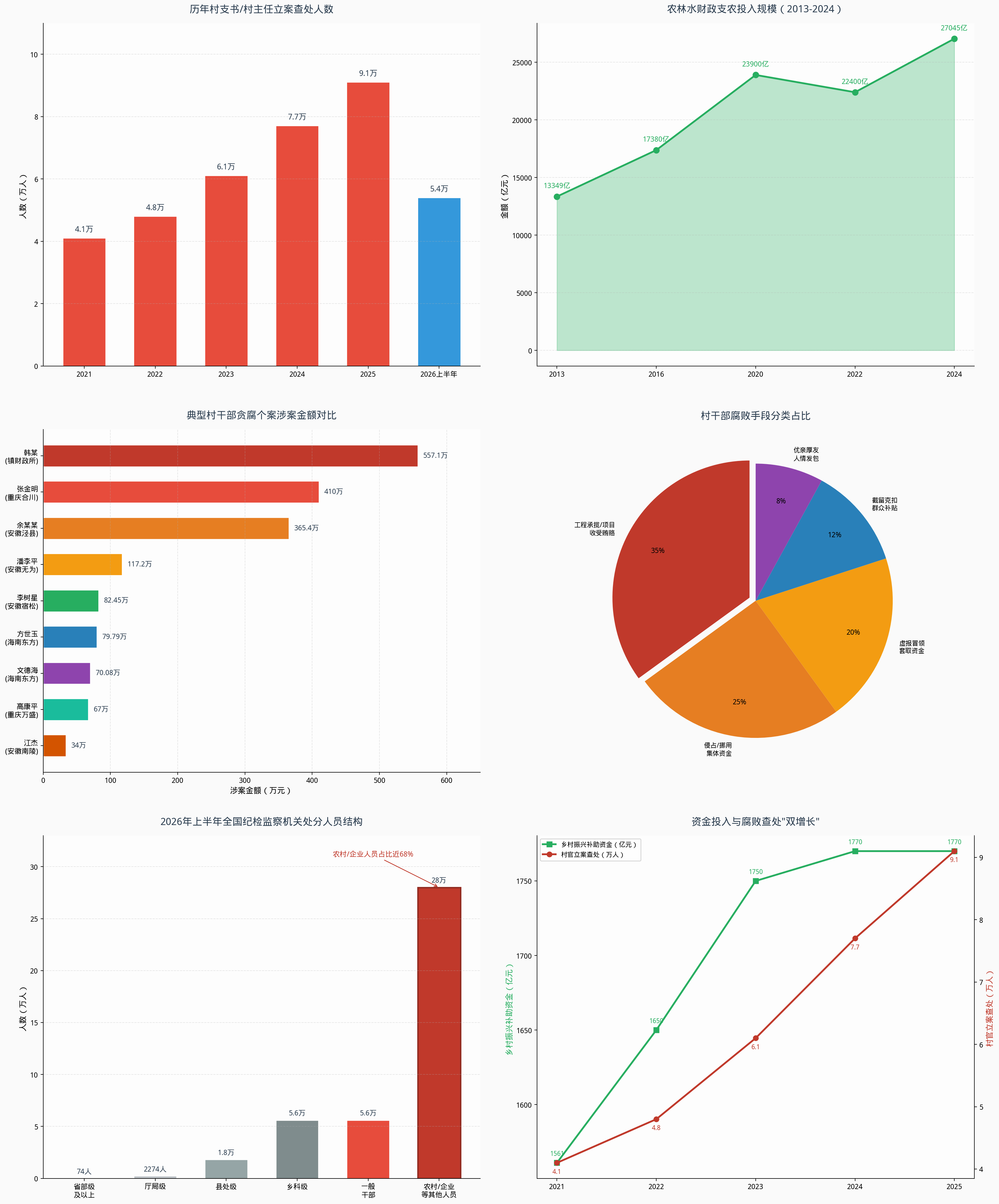
Figures 1–6: Trends in the number of village officials prosecuted over the years / Scale of rural revitalization fund allocation / Comparison of amounts involved in typical cases / Classification and proportion of corruption methods / Structure of personnel subjected to disciplinary actions nationwide / Concurrent growth of fund allocation and corruption cases.
8.2 Explanation of Chart Data
Figure 1: Number of village Party secretaries and village heads prosecuted over the years
- Annual figures from 2021–2025: 41,000 → 48,000 → 61,000 → 77,000 → 91,000 (persons)
- First half of 2026: 54,000 persons (half-year data)
- The increase over five years exceeds 120%.
Figure 2: Fiscal expenditure on agriculture, forestry, and water conservancy (2013–2024)
- Rising from 1,334.9 billion yuan in 2013 to 2,704.5 billion yuan in 2024, representing a doubling of investment.
Figure 3: Comparison of amounts involved in typical cases (in ten thousand yuan)
- Han Mou (Town Finance Office): 557.1万
- Zhang Jinming (Hechuan, Chongqing): 410万
- Yu Moumou (Jingxian, Anhui): 365.4万
- Pan Liping (Wuwei, Anhui): 117.2万
- Li Shuxing (Susong, Anhui): 82.45万
- Fang Shiyu (Dongfang, Hainan): 79.79万
- Wen Dehai (Dongfang, Hainan): 70.08万
- Gao Kangping (Wansheng, Chongqing): 67万
- Jiang Jie (Nanjing, Anhui): 34万
Figure 4: Classification and proportion of corruption methods
- Contracting engineering projects or accepting bribes: 35%
- Embezzlement or misappropriation of collective funds: 25%
- False reporting or fraudulent acquisition of funds: 20%
- Withholding or deducting subsidies meant for villagers: 12%
- Favoring relatives or friends in contracting decisions: 8%
Figure 5: Structure of personnel subjected to disciplinary actions by national disciplinary inspection and supervision agencies in the first half of 2026
- Rural and enterprise-related personnel accounted for nearly 68% (approximately 280,000 persons), constituting the largest group among all categories.
Figure 6: Concurrent growth of fund allocation and corruption cases
- Rural revitalization subsidy funds increased from 156.1 billion yuan to 177 billion yuan.
- The number of village officials prosecuted rose from 41,000 to 91,000.
- The parallel upward trend of these two indicators highlights the lag in supervisory mechanisms relative to the growth in fund allocation.
IX. Data Sources
All data presented in this paper are derived from the websites of the Central Commission for Discipline Inspection and the National Supervisory Commission, official bulletins issued by provincial and municipal disciplinary inspection and supervision commissions, as well as publicly released information from the National Bureau of Statistics and the Ministry of Finance.
Main Sources
- Bulletin by the Central Commission for Discipline Inspection and the National Supervisory Commission on the supervision, inspection, and investigation activities of national disciplinary inspection and supervision agencies in the first half of 2026
- “In-depth Focus | Strengthening the Governance of Irregularities in the Use of Rural Revitalization Funds” – Central Commission for Discipline Inspection and National Supervisory Commission website
- “Targeted Efforts to Combat ‘Fly-level Corruption’” – China Discipline Inspection News
- “Continuously Improving the Efficiency of Fiscal Investment in Comprehensive Rural Revitalization” – People's Tribune website
- “Future Improvements to the Rural Revitalization Investment Mechanism” – Chinese government website
- Press conference on the achievements of fiscal reform and development during the 14th Five-Year Plan period held by the State Council Information Office
- “In-depth Focus | Ensuring Effective Oversight of Power at the Grassroots Level” – Central Commission for Discipline Inspection and National Supervisory Commission website
- “Journalist’s Observation | Addressing the Challenges of Supervising Grassroots Networks Shaped by Personal Relationships” – Central Commission for Discipline Inspection and National Supervisory Commission website
- “Village Party Secretary Embezzles Over 3 Million Yuan; Chongqing Publishes Four Typical Cases” – Legal Network
- “No Matter How Numerous ‘Fly-level Corruption’ Cases Are, They Must Be Eradicated” – Clean Ningbo
- “The ‘Fallen Leader’” – Chongqing municipal government website
- “Notice on Eight Typical Cases of Misconduct and Corruption in the Field of Rural Revitalization” – Jin’an District Discipline Inspection and Supervision website
- “Yunnan Shuifu Pursues Clues and Implements Rectifications to Standardize the Management of Collective Assets, Funds, and Resources” – Zhaotong City Discipline Inspection and Supervision Commission website
- “Hunan Changde Strengthens Oversight of the Use of Rural Revitalization Funds” – Central Commission for Discipline Inspection and National Supervisory Commission website
Notes
Some cases involve personal privacy; therefore, pseudonyms (e.g., “Yu Moumou,” “Huang Zhongming”) are used, as specified in the official bulletins. The number of village officials prosecuted in certain years is a reasonable estimate based on publicly available data and does not represent official statistics.
Conclusion
The essence of rural revitalization lies in the modernization of grass-roots governance. If power at the “last mile” remains opaque, reliant on personal discretion, or dominated by familial networks, any increase in financial investment will merely shift resources from one pocket to another. If villagers continue to be mere recipients of notifications rather than genuine decision-makers in governance, even the most aesthetically pleasing village landscapes will remain mere illusions.
What we need is not a charismatic village Party secretary, but a governance mechanism that enables ordinary people to effectively monitor power. We require not only an increase in the number of cases prosecuted but also a system that prevents individuals from engaging in corrupt practices in the first place.
This is the most challenging and unavoidable task in rural revitalization.

评论 理性讨论,文明发言