I. This is not a problem of “the hardship of studying,” but of “the exhaustion of studying”
Many people habitually attribute the fatigue experienced by Chinese students to traditional notions such as “one must endure great hardship to become an exceptional person” or to motivational narratives like “heaven imposes great responsibilities on those it chooses.” However, such explanations are neither accurate nor fair; they even obscure the underlying issues.
The fatigue faced by Chinese students is fundamentally different from the hardships endured by ancient scholars who studied under extreme conditions. The hardships of the past were the result of individual choice: if one chose not to study, no one compelled him to do so; he could simply return to farming and still lead a viable life. In contrast, the fatigue of Chinese students stems from systemic coercion: even if one does not wish to participate in the race, everyone else is running, and stopping would result in being left behind. Students do not run merely to “get ahead”; they run to avoid being eliminated.
This is not a story about “effort” per se, but rather a story about structural pressure.
Let us begin with the most straightforward observation: what does a typical day for a Chinese middle or high school student look like?
They wake up before 6 a.m. and arrive at school before 7 a.m. They attend four to five classes in the morning, each lasting 45 minutes with 10-minute breaks. Lunch breaks are often reduced to half an hour or less; in many schools, students either nap at their desks or are required to attend supplementary tutoring sessions led by teachers. Afternoon classes follow, typically three to four periods. If the student attends junior or senior high school, evening self-study sessions usually follow—lasting from 6:30 p.m. to 9:30 p.m., or even 10 p.m. Upon returning home, it is common for students to spend another two to four hours completing homework, often until 11 p.m. or midnight. What about weekends? They are consumed by extracurricular activities such as math Olympiad training, English lessons, piano lessons, programming courses, essay writing workshops, and physics competition preparatory classes.
On average, a junior high school student dedicates 12 to 14 hours per day to study, with no days off. For high school students, the situation is even more extreme: many senior three students follow a minute-by-minute schedule—waking at 5:30 a.m., beginning self-study in class at 6:00 a.m., having lunch and a brief rest at 12:00 p.m., attending classes until 6:00 p.m., engaging in problem-solving sessions until 10:00 p.m., and going to bed at 11:30 p.m. or later. This is not the routine of a few exceptional “top students” but rather the standard schedule in many ordinary schools.
For comparison, international data reveal that Finnish secondary school students spend approximately 5 hours per day on study, Japanese students about 6 to 7 hours, and American public school students generally 6 to 7 hours. Although South Korea also faces significant academic pressure, its secondary school students dedicate about 8 to 9 hours per day to study. The time Chinese students spend studying exceeds the global average by more than double.
Yet, is the return on this time investment proportional? Not necessarily. Many students spend vast amounts of time on repetitive exercises, copying tasks, and low-efficiency problem-solving—activities with minimal marginal utility. However, these activities occupy most of their time, leaving them with no opportunity to rest. For instance, a student might spend three hours copying English words ten times, yet the cognitive benefit of such an activity may be inferior to spending twenty minutes on a reading comprehension exercise. Yet copying is a “mandated task,” whereas reading comprehension is “optional”—under the examination-oriented system, completing tasks takes priority.
This constitutes the first dimension of the exhaustion experienced by Chinese students: time is extremely constrained, and a large portion of it is spent on inefficient, repetitive labor.
II. The most insidious exhaustion: the extreme uniformity of the evaluation system
The exhaustion of Chinese students stems from the fact that all their efforts converge toward a single endpoint—the National College Entrance Examination (Gaokao).
Do athletic or artistic talents, vocational skills, or entrepreneurial aspirations offer alternative pathways? Such routes exist, but in terms of societal recognition and resource allocation, they pale in comparison to the pathway of gaining admission to a prestigious university. Parents may verbally affirm that “every profession has its masters,” but they practically enroll their children in tutoring classes. This is because everyone understands that, within the current social structure, a diploma from a 985 or 211 university signifies a completely different starting point compared to a diploma from an ordinary undergraduate or vocational college.
What does this imply? It means that over ten million examinees compete on a single track with virtually no flexibility. Gaining one additional point can allow a student to surpass thousands of others—this is the reality of the “one-point gap affecting thousands of people” phenomenon. In some provinces, a one-point difference can translate into a ranking gap of tens of thousands of places. Under such logic, any reduction in study time is perceived as risky, while any increase is viewed as a safeguard.
Consequently, an absurd situation arises: a student who can already score 140 out of 150 on a mathematics exam may still spend considerable time tackling the final 10 points of challenging problems. Not because he wishes to learn them, but because he dare not refrain from doing so. Those 10 points could determine whether he gains admission to Tsinghua University or a 985 university. When one point equates to a gap of tens of thousands of ranks, no one dares to forgo any possibility of gaining even a single extra point.
This uniform evaluation system also creates a deeper problem: it equates “learning” with “taking exams.” Students do not learn out of curiosity or to understand the world; they learn solely to obtain high scores. A student with a keen interest in biology may spend vast amounts of time memorizing definitions of cellular structures rather than conducting actual biological experiments. A student who enjoys history may focus on memorizing the dates of historical events rather than comprehending the social structures of those eras.
Learning ought to be a process of exploring the world; however, within the examination-oriented system, it becomes a form of “answering training.” This alienation induces exhaustion not because learning itself is inherently arduous, but because students engage in activities devoid of intrinsic motivation. It is akin to being asked to run 10 kilometers daily: if done in preparation for a marathon, the task may be exhausting but fulfilling; yet if coerced at gunpoint to run or face execution, the same 10 kilometers become a form of torture.
III. The most cruel exhaustion: the叠加 of familial expectations and class anxiety
In China, education is never merely a matter concerning the child alone; it is a “collective endeavor” of the entire family.
The legacy of the one-child policy persists: although policies permitting second and third children have been implemented, a large proportion of current school-aged students are still children of single-child families. With only one child, that child bears the expectations of two or even three generations of parents. In many families, a child’s academic performance directly equates to family prestige, future security, and the maintenance of social status.
I have witnessed countless instances where a mother broke down in tears at a parent-teacher meeting because her child ranked tenth in class—not because tenth place is inherently poor, but because “the child of the neighbor, Lao Wang, ranked third.” Such comparisons are not isolated incidents; they constitute a pervasive cultural atmosphere in Chinese families. A child’s academic performance is not only his own concern but also a form of “hard currency” in family social interactions.
A deeper issue lies in class mobility anxiety. In an era of gradually declining social mobility, education is widely regarded as the “last pathway to upward mobility.” When parents perceive that “failure to advance means regression,” the pressure they impart to their children multiplies exponentially. Students feel exhausted because they bear not only their own future but also the expectations of their entire family.
This pressure does not stem from a lack of parental love; quite the contrary, it often arises precisely from love—parents push their children because they fear they will lead a suboptimal life in the future. Yet the weight of love can sometimes be more suffocating than hatred. One student described his feelings as follows: “I know my parents are doing this for my benefit, but every time I see their expectant looks, I feel as though I am carrying a mountain on my back. I am not studying for myself; I am studying to avoid disappointing them.”
This statement reveals a heartbreaking logic: when the purpose of learning shifts from “who I want to become” to “I do not want to disappoint those who love me,” the motivation for learning transitions from internal to external. The problem with external motivation is that it is consumptive—one requires ever-increasing external pressure to sustain operation; once that pressure is removed, the entire system ceases to function. This explains why many Chinese students experience “revengeful inactivity” after the Gaokao: not because they are lazy, but because their previous motivation never originated from within.
IV. The most overlooked exhaustion: sleep deprivation and psychological costs
Data from the Chinese Youth Research Center indicate that over 60% of middle and high school students sleep less than 8 hours per night. Junior high school students average 6.5 to 7 hours of sleep, while senior high school students—particularly those in their final year—often sleep only 5 to 6 hours per night. Meanwhile, the medical consensus holds that adolescents require 8 to 10 hours of sleep daily.
Chronic sleep deprivation has pervasive effects on adolescents: decreased attention span, impaired memory, poorer emotional regulation, weakened immunity, and a significantly increased risk of depression and anxiety. A sleep-deprived brain exhibits markedly reduced learning efficiency; in other words, much of the time spent studying late at night involves low-efficiency or even ineffective learning. This creates a vicious cycle: low efficiency necessitates more time; more time spent studying leads to less sleep; less sleep further reduces efficiency.
Even more alarming are the psychological health issues. According to the China National Mental Health Development Report published by the Institute of Psychology, Chinese Academy of Sciences, the detection rate of depression among adolescents exceeds 20%, with severe depression affecting approximately 4% to 8% of this group. This proportion is even higher at the secondary school level. Many students remain in a state of psychological “sub-health”: experiencing anxiety, insomnia, difficulty concentrating, low mood, and loss of interest in activities.
Behind these numbers lie children who are suffocated by pressure. I recall one case: a female student from a key high school, consistently ranked among the top performers, suddenly began experiencing frequent headaches and stomachaches during her second year of high school. Medical examinations revealed no organic abnormalities. Subsequently, a psychologist diagnosed her with severe anxiety disorder—her body was sending distress signals through pain, yet her schedule left no room for rest.
Another less apparent issue is the general lack of the ability to experience boredom among Chinese students. Boredom is not inherently detrimental; rather, it serves as a breeding ground for creativity, a space for self-reflection, and a necessary process for the brain to organize information. However, the schedules of Chinese students are excessively packed; they lack time to daydream, to engage in idle activities, or to simply sit and ponder seemingly “useless” thoughts. Every minute of their time is assigned a specific purpose—either dedicated to formal learning, tutoring, or preparation for exams. This continuous high-intensity stimulation keeps the brain in a state of stress, leaving it with no opportunity for recovery.
V. The Most Ironical Burden: The Paradox of “Reducing Academic Load” Policies
Ironically, China may be the country with the most “reducing academic load” policies in the world. Since the Ministry of Education first proposed measures to alleviate the homework burden on primary and secondary school students in 1988, dozens of such policies have been issued over the past three decades. In 2018, the Ministry even established a dedicated office for this purpose. Yet the outcome? Rather than decreasing, the burden on students has actually intensified.
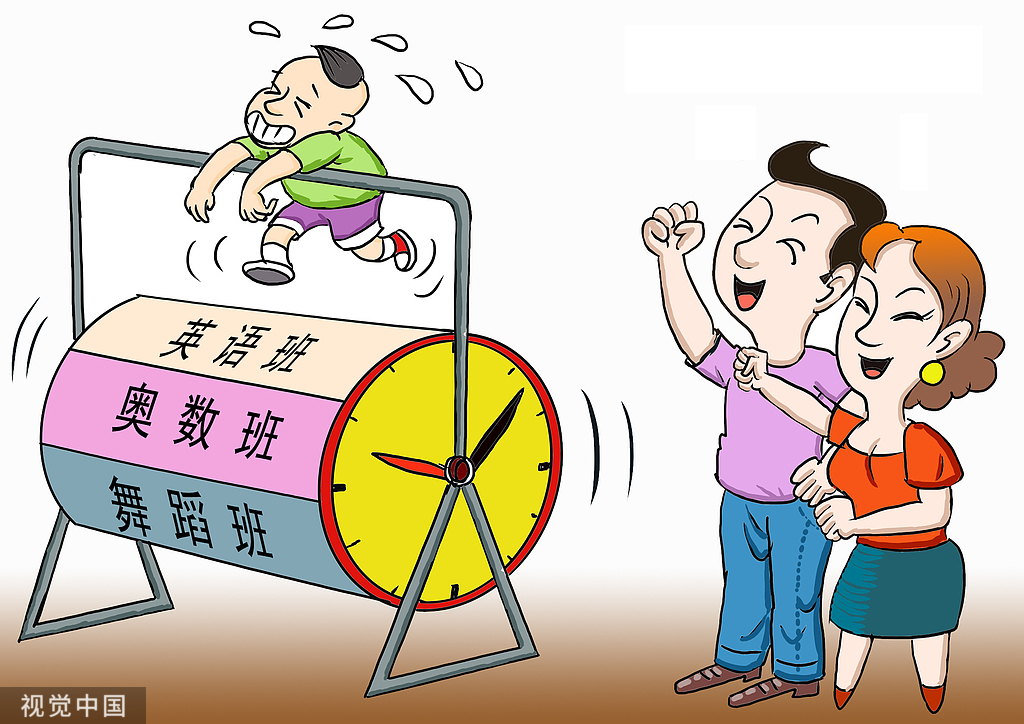
Why? Because these policies often address only the “supply side” while neglecting the “demand side.” Schools reduce the amount of homework assigned, but parents immediately enroll their children in private tutoring programs. Schools取消 mid-term exams, but parents purchase additional practice materials for their children. Schools delay class start times, but tutoring centers simply begin their sessions earlier.
This resembles a paradox: the government mandates “no overtime,” and companies respond by eliminating overtime pay while maintaining the same workload—resulting in employees working unpaid at home.
A deeper issue is that these policies seldom confront the core contradiction: the college entrance examination system. As long as this examination remains the primary determinant of educational and career outcomes, and as long as attending a prestigious university remains the top priority for virtually all families, any attempt to reduce study time will encounter silent resistance from parents. Their logic is simple: if other children continue studying, why should mine rest?
This exemplifies a classic “prisoner’s dilemma.” Every parent recognizes that excessive competition is detrimental to everyone, yet no parent dares to be the first to withdraw. The cost of withdrawal is too high—if a child’s academic performance declines after the implementation of such policies, who will bear responsibility? No one is willing to risk their child’s future as an experiment.
Consequently, “reducing academic load” policies often fall into a vicious cycle: policies are introduced → schools comply → parents panic → private tutoring proliferates → policies are intensified → tutoring moves underground → the burden increases further. Each attempt to reduce load merely shifts it—from schools to private institutions, from overt to hidden, and from legal to grey-market channels.
The 2021 “Double Reduction” policy represented an unprecedented effort to tackle both the supply side (by closing for-profit tutoring agencies) and the demand side (by restricting school-based exams and rankings). Nevertheless, the outcomes remain complex. On one hand, many families indeed experienced reduced financial and time burdens; on the other hand, some families became more anxious due to a lack of accessible tutoring options and resorted to more covert and costly one-on-one tutoring arrangements.
VI. The Deepest Problem: Severe Imbalance in Educational Resources
Another fundamental reason for the heavy burden on Chinese students is the extreme scarcity and uneven distribution of high-quality educational resources.
How many 985 universities are there in China? 39. How many 211 universities? 116. Yet over 10 million students take the college entrance examination each year. This means that even scoring within the top 5% nationally does not guarantee admission to a 985 university. In provinces with particularly high examination volumes—such as Henan, Shandong, and Hebei—competition is even more intense. Henan alone has over 1.3 million examinees, yet it has no 985 universities within its borders.
This imbalance persists not only at the tertiary level but also in basic education. Key primary schools, junior high schools, and high schools concentrate the best teachers, facilities, and student cohorts. Admission to these institutions hinges solely on academic performance. Consequently, competition begins as early as kindergarten—through housing located in designated school districts, entrance interviews, and examination-based admissions. Each stage functions as a selective process, inevitably resulting in the elimination of some candidates.
The junior high school entrance examination represents perhaps the most brutal stage of this process. In many provinces, only about 50% of junior high school graduates gain entry to regular high schools, while the remainder attend vocational high schools. Although the intended purpose of this policy is to cultivate technical talent, the societal perception of vocational education remains markedly inferior to that of regular high schools. For many families, attending a vocational school is akin to personal failure. Thus, the pressure of the junior high school entrance examination rivals that of the college entrance examination—it effectively determines a student’s trajectory at the age of 15.
Such resource imbalances foster a “zero-sum game” mentality: your success equates to my failure, and your admission slot represents my loss. Under such conditions, cooperation and knowledge sharing become impossible, as everyone strives desperately to move forward. This resembles a room with only one exit that suddenly catches fire—everyone rushes toward it, not out of malice, but simply because the exit is too small to accommodate all simultaneously.
VII. International Comparison: Are Students in Other Countries Also Overburdened?
Some might argue that students in other countries face similar pressures—South Korea, Japan, and Singapore, for instance. Indeed, East Asian cultures commonly exhibit high academic stress. However, a closer comparison reveals distinct characteristics of the burden experienced by Chinese students.
South Korea and Japan also have college entrance examinations and tutoring cultures, but several key differences exist:
First, although the education systems in South Korea and Japan are highly competitive, vocational education enjoys relatively higher social recognition. In Japan, for example, technical workers often enjoy respectable social status and income levels. In contrast, the notion that “all occupations are inferior except scholarship” remains deeply ingrained in Chinese society, leading to the severe stigmatization of vocational education.
Second, although students in South Korea and Japan face heavy workloads, they possess more time for extracurricular activities and social interaction at school. In Japanese high schools, club activities constitute an essential component of school culture, allowing students to devote substantial time to sports, music, art, and other interests. In Chinese high schools, nearly all time is consumed by academic studies, making extracurricular activities a luxury.
Third, and most importantly, South Korea and Japan have already undertaken substantial educational reforms. South Korea introduced the “free semester system” in the 2000s to allow students more time for exploring personal interests. Japan implemented the “relaxed education” policy, which reduced class hours and homework loads (although this policy remains controversial, it at least acknowledges the principle that “less can be more”). In China, despite repeated policy statements advocating for reduced academic load, schools, parents, and students collectively lack the space to truly relax.
VIII. Why Is This System So Difficult to Change?
Many people ask: if everyone recognizes the adverse effects of this system, why not reform it?
The reason lies in the fact that this is not a problem confined to a single component but rather a tightly interconnected system:
The college entrance examination provides a relatively fair selection mechanism but also establishes a singular evaluation criterion. In a vast and economically uneven country like China, this examination remains the fairest means of selection—it disregards one’s background and connections, focusing solely on test scores. While this “score-based” approach has its merits (fairness), it also has significant drawbacks (oversimplification). Replacing it requires a more complex and refined alternative, which has yet to emerge.
The uneven distribution of educational resources turns access to quality schools into a zero-sum game. This issue stems from regional economic disparities in China. Addressing it would require substantial financial investment and policy adjustments—challenges that extend beyond the scope of the education sector alone.
The job market’s rigid reliance on academic qualifications makes degrees a form of “hard currency.” Why do employers prioritize academic credentials? Because, in the absence of better screening mechanisms, degrees serve as the lowest-cost signal of competence. Changing this necessitates a more diversified societal evaluation system and a genuine improvement in the quality and social recognition of vocational education.
Societal definitions of “success” in China are highly homogenized. In Chinese context, “success” is almost synonymous with “wealth + status + social prestige.” This singular notion of success drives everyone toward the same goal. Altering this requires a prolonged process of cultural transformation.
Under conditions of information asymmetry, parents make what they perceive as the “optimal” collective choice. Each parent acts in the best interest of their own child, yet the aggregate effect of these individual optimal decisions results in a suboptimal outcome for the entire society. This constitutes the essence of “involution.”
Each component appears reasonable when considered in isolation; however, when combined, they form a self-reinforcing high-pressure system. No individual—whether students, parents, teachers, or schools—can remain unaffected within this system. If one party reduces the burden while others do not, the children of that party will inevitably be at a competitive disadvantage.
IX. What is the way forward?
Having discussed these issues at length, is there a viable solution?
I argue that genuine change requires simultaneous progress across multiple dimensions:
First, the reform of the national college entrance examination must be further deepened. The current reforms—such as the elective subject system and comprehensive quality assessment—represent a positive direction; however, they have not fundamentally altered the paradigm of “one exam determining one’s entire future.” In the future, more diversified admission methods may be required, such as increased emphasis on interviews, greater weight given to regular academic performance, and expanded pathways for students with special talents. Such reforms must be implemented with extreme caution, as any mishandling could undermine fairness—a principle that is utterly unacceptable in Chinese society.
Second, educational resources need to be allocated more equitably. Although this cannot be achieved overnight, certain measures can be taken: improving the remuneration of teachers in rural and underdeveloped areas to attract qualified educators; promoting the digital sharing of high-quality educational resources so that students in remote regions can access superior instruction; and restricting the expansion of “super schools” to prevent the excessive concentration of elite resources.
Third, vocational education must be genuinely elevated to a respected status. This requires coordinated efforts involving policy, funding, and societal attitudes. The German dual vocational training system serves as a model worth emulating: students alternate between practical training in enterprises and academic study in schools, thereby acquiring professional qualifications upon graduation, with relatively high social status and income levels.
Fourth, society needs to adopt more diverse definitions of success. This is not merely a slogan but requires concrete institutional support: for instance, raising the income and social status of skilled workers; ensuring that pathways such as entrepreneurship, freelancing, and artistic creation are socially recognized; and incorporating “happiness,” “health,” and “a meaningful life” as criteria for evaluating personal success.
Fifth, and most importantly, students must be granted more time for undirected activities. They need time to daydream, to play, and to explore their interests. True creativity and curiosity are not cultivated through endless problem-solving exercises but emerge from the freedom to explore.
X. Conclusion: Fatigue is not a sin; meaningless fatigue is
The fatigue experienced by Chinese students should not be simplistically attributed to “delicacy” or “lack of effort.” The pressures faced by this generation surpass those encountered by their parents at the same age in many respects. Although their parents may have had poorer material conditions, they enjoyed more time for play, greater freedom of choice, and more opportunities to learn from mistakes.
However, it is essential to distinguish between two types of fatigue: one arises from striving toward genuinely desired goals; although arduous, such fatigue provides a sense of direction and meaning, thereby facilitating personal growth. The other stems from being compelled to run tirelessly along a path ill-suited to one’s abilities; this type of fatigue is destructive, eroding curiosity, creativity, and enthusiasm for life.
Currently, the fatigue experienced by Chinese students largely falls into the latter category. Many of them do not even know why they are studying—not because they lack dreams, but because their dreams are overshadowed by the single objective of “entering a prestigious university.” It is not that they do not wish to have dreams; rather, they lack the space to contemplate them.
What truly needs to change is not fatigue itself, but the meaninglessness of that fatigue—ensuring that every child enjoys greater freedom of choice, that evaluation systems become more diverse, and that education returns to its fundamental purpose of “cultivating human beings” rather than merely “selecting individuals.”
This path is long and may require a generation or more to yield substantive change. Nevertheless, recognizing the problem constitutes the beginning of change. At least when we discuss “why Chinese students are so fatigued,” we no longer attribute it to “lack of effort” or “delicacy,” but instead examine the system that forces them into such a situation.
Every Chinese student deserves the right to pause and catch their breath when fatigued, to find space to discover their own direction when lost, and to understand the purpose behind their efforts when striving.
This is not an extravagant request; it is what they ought to have.

评论 理性讨论,文明发言